WHY HISTORY SIMULATIONS WORK
CREATE AN ENGAGING CLASSROOM WITH INTERACTIVE, HANDS-ON HISTORY SIMULATION MAP ACTIVITIES
Need to pitch simulations to your admin? Download our administrator justification one-pager and get your department on board.
History Simulations and Map Activities promote the social and emotional growth of kids, logical reasoning and decision making.
Simulations increase social interaction and enhance problem solving skills, individually, as well as in a group setting.
History Simulations are a unique way to increase students' interest and enthusiasm for history! Using simulations for education not only makes learning fun, but also increases understanding of why events in history happened. "Don't think they aren't learning just because they're having fun.
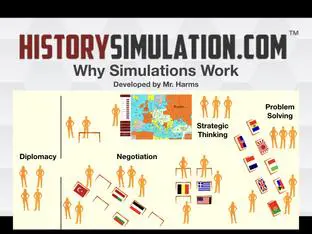
How Simulations can create an Interactive Classroom
What are the benefits of using History Simulations and Map Activities?
Students that have problems paying attention or staying focused because they find History boring or that have ADD or ADHD, seem to really get involved in the simulations. Barkley says that interesting, challenging and meaningful experiences are more apt to keep students with ADHD motivated and engaged. Since students with ADHD function in the realm of the immediate, he says they may not work for delayed rewards such as grades: the reward must be in the task itself. History Simulations are sometimes the "hook" you need to get students engaged and more involved. When we have completed either the World War One Simulation or World War Two Simulation students ask more questions and discussion is a thousand times better as we study what really happened. ADHD Building Academic Success
Simulations engage students to take a broad, long range approach to problem solving and decision making. Strategic thinkers are the most effective leaders. Strategic thinkers understand how their actions affect others and predict what reactions to expect. Students learn the advantages of strategic thinking and begin to apply those lessons to the real world.
Simulations are centered around a problem (completing their objectives) and students are challenged to solve those problems. Each simulation generates hundreds of problems and situations that must be solved by the students.
Simulations inherently have a certain amount of "free will" designed into them. Although the teacher needs to keep the simulation within the historical context they are teaching, students have the flexibility to create their own theories and solutions.
Leaders, in the simulation, must make decisions without knowing how the other leaders might react. This causes the student to anticipate what their opponents reaction might be and that requires some higher order thinking.
Simulations often operate on an action-reaction principle. Students, as leaders, make decisions and other leaders react to those decisions. Just like in the real world, decisions are made and there are always consequences to those decisions. Students learn that consequences not only affect themselves, but affect their allies (friends) and others.
During the course of the simulation, students build a template in their minds of the political and natural structure of the world and the countries involved. Students also gain a logistical understanding of the regions: seas, oceans and trade routes. After the Simulation is over and you begin discussing what really happened, students are a lot more interested and engaged.
Students learn not only about the country they are assigned, but also the other countries involved in the simulation. Students are then able to understand each country's self interest, advantages and disadvantages.
Students learn the advantages and disadvantages of an alliance and also develop an awareness of the danger alliances can create. These lessons can be applied to their own personal situations in life and may help them understand how their actions affect others.
Students understand how the history of each nation and or region, influences the decision making process in each country.
Students will understand how specific events affect countries, which in turn determines or changes that countries policies and actions.
Students will understand how technology, or lack of technology, has a dramatic affect on society and the battlefield. Students will understand how natural resources are the life blood of an industrial economy and how nations will do almost anything to control them.
Students will be engaged in diplomacy with other countries as they seek to solve problems and avert crisis. Students will learn to assess other country's self interest in order to make deals and ensure their own countries security.
Articles and Research on the Effectiveness of Simulations
History Simulations are designed to:
- Engage Students
- Enhance Strategic Thinking Skills
- Improve Problem Solving Skills
- Stimulate Imagination and Creativity
- Encourage Exploration
- Teach Consequence
Ready to bring real diplomacy and active problem-solving to your classroom? Browse our ready-to-use History Simulations
- Learning Political and Physical Geography
- Country's Situation and Circumstances
- Alliance Systems
- History's Impact On The Present
- Interconnectedness of Regions and the World
- Impact of Technology and Resources
- Engage In Real Diplomacy
Better to Drill Deep with understanding than shallow across many topics!
Additional Information
History Simulations For The Classroom